koolcast
Legacy Member
BuYcKi zei:Mooimooi!
Wil wel eens meer beelden zien.
Een beetje geduld

So we’ll have plenty of news and videos to share with you in the coming weeks and months.
Volg de onderstaande video om te zien hoe je onze site als web-app op je startscherm installeert.
Opmerking: Deze functie is mogelijk niet beschikbaar in sommige browsers.
BuYcKi zei:Mooimooi!
Wil wel eens meer beelden zien.
So we’ll have plenty of news and videos to share with you in the coming weeks and months.
On a purely mechanical level, this is what it’s like to play Beyond.
You move Jodie with the left stick. You push it forwards and she walks in third-person, looking around her as she goes. The general UI is different from Heavy Rain’s. If Jodie is able to interact with an object, a small white circle appears next to it. You then move the right stick in the direction of the circle to complete an action. This could be getting up, crouching down, searching or whatever else.
The one thing that stuck out from my short time playing is how much you use Aiden, the ghost, who is accessed by pressing the triangle button. When you switch over to Jodie’s spooky friend, the controls become first-person in a traditional twin-stick format. The R1 and R2 buttons are used to raise and lower the camera. Aiden can fly through walls, hit objects and show Jodie flashback sequences based on the aura of corpses. This forms the basis of a great deal of the progression we saw.
Quantic Dream has done away with QTEs in the fighting sequences, and has instead employed a system of stick movements and bullet-time. Jodie was sparring with a partner in the gym is the segment we saw, and every time he tried to hit her his strike slowed down, giving the player enough time to counter it by moving the right stick. Every action is controlled in this way. If you compare it to the combat in Heavy Rain, in which everything was controlled by a blatantly obvious QTE press, it’s easy to see how Quantic’s built on previous work by refining.


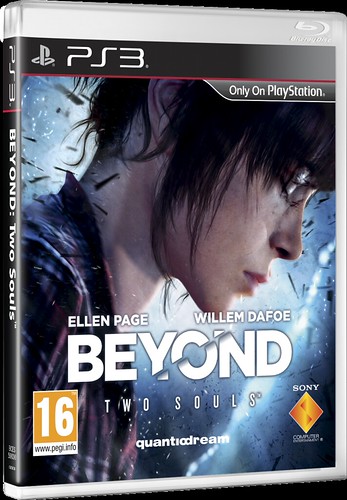
Cage invited us to gawp at his new PlayStation 3 game, Beyond: Two Souls.
Like the studio's previous effort, Heavy Rain, it's billed as an epic, innovative and emotional interactive narrative experience, underscored by cinematic presentation and really believable hair. "But don't expect a clone," says Cage. "We wanted to make a different game, and this is exactly what we did."
[...]
“Each scene offers you a different challenge. Each scene is unique, like you see in a film,” he said. “The game’s story is told in chronological disorder, like in the film Memento. It creates an interesting dynamic. Sometimes you can see the consequences of something before seeing the cause.”
This could mean in on scene the player is met with a teenage Jodie, in the next she is an adult, and the next a child. Each scene contains part of the plot and a line to occurrences in the game, but the full story of the scene may not come into play until a while later.
“It’s about asking the player not just to watch the story passively, but contribute to the story at a macro level – to try to understand it and put the pieces of the puzzle together,” explained Cage. “It creates another layer of interactivity that is quite interesting.
“Beyond is the story of two characters. It’s the story of their relationship. It’s about being tied to someone for all your life and having to cope with that, and accept it.”
Because of what appears to be a convoluted and complex story, Cage and his team wanted to do more than just hire actors to apply their voices to the title, nor did the developer hire such high-profile Hollywood talent as Williem Dafoe and Ellen Page just to put a “shiny name” on the packshot. Instead, the team spent 12 months shooting mo-cap which resulted in 300 characters and 23,000 animations when all was said and done – a number Cage called “absolutely, totally insane.”
“It was a crazy amount of work. I was looking for a creative collaboration with talent,” he said. “We did not pay some actors in Hollywood to do a couple of voiceovers in a soundbooth… It was about scanning the face and body of these people to recreate their perfect clone in the game, in realtime 3D. We don’t only have their look, we have their movements and their expressions. Their entire performance is recreated.
“That means we need a specific animation for pretty much every single action in the game. If you open a door in an action game, you just open a door. In a narrative-driven experience, opening a door can be done in many different ways. You can be in your apartment just opening a door, and that’s it. But if you fear what’s on the other side, then it’s a different way of opening the door.”
Meanwhile, de Fondaumière added further ambiguity to the ongoing speculation that Beyond, due out in October, will be ported to PS4.
Following mixed messages, we asked the Quantic Dream executive whether the game would be released for Sony's next-gen console.
"That's not been decided yet," he replied.
“This performance is going to change people’s and gamers’ perception of how a character needs to behave in a video game. Probably, when people will see Beyond – other studios – they will want to have a great talent in their games, too, because we’re going to see a difference, and it’s going to be striking.”
“Having produced Heavy Rain, and being able to show it to people, to show them that we were doing different experience, more a form of cultural expression – that opened the doors. And when I contacted the agents for collaboration [with] Willem and Ellen, it was relatively easy, because people had seen Hollywood in Heavy Rain, they had either played it or heard of it, so it made it much simpler for me than years before.”




 -->
--> 